


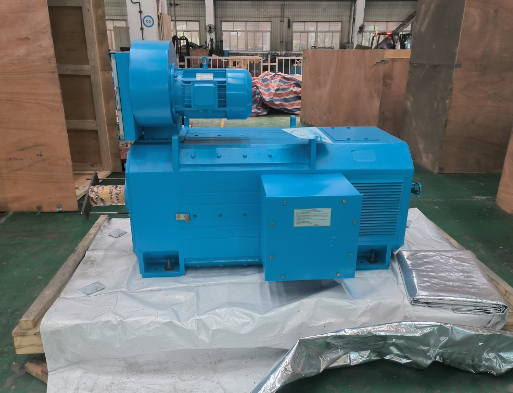


What are the differences between variable frequency motors and ordinary industrial frequency motors?
Motors are one of the common electrical appliances in daily life. What are the differences between variable frequency motors and ordinary industrial frequency motors?
Motors are electromagnetic devices that rely on the principle of electromagnetic induction to realize motor energy and transmission. Its main function is to generate driving torque as a source of electrical or mechanical power.

Ordinary motorsand variable frequency motors are both Asynchronous Motors. Its working principle: The stator winding of the motor is a three-phase winding that is symmetrical in space. When a three-phase symmetrical AC current is added to the stator winding, a rotating magnetic field will be established inside the motor. This rotating magnetic field cuts the rotor winding, thereby generating an induced current in the rotor winding. The current-carrying rotor will generate electromagnetic force under the action of the stator rotating magnetic field, thereby driving the motor to rotate.
Variable frequency motors and ordinary industrial frequency motors Ordinary motors are more common, but what are the advantages of variable frequency motors compared to ordinary motors?
- Variable frequency motors can work at very low frequencies and voltages. And they can be started without impact current. Various braking methods provided by the inverter can be used for rapid braking to achieve frequent starting and braking. Because variable frequency motors can achieve more demanding operations and harsher operating environments than ordinary motors. Therefore, variable frequency motors have higher insulation levels than ordinary motors in manufacturing, forced cooling systems (built-in cooling fans), stronger mechanical strength in structure, better rotor bearings and longer service life than ordinary motors.
- As we all know, ordinary motors can only work under the condition of 50 Hz power frequency. If the frequency variation range is too large, the motor will heat up seriously or even burn the motor. However, variable frequency motors can adjust the speed of the motor at any speed within the speed range without damage. Under normal circumstances, variable frequency motors can work continuously within the rated speed range at full rated load, and the temperature rise of the motor will not exceed the motor calibration value.
- Although variable frequency motors are slightly more expensive than ordinary motors in price, their advantages are very obvious. The AC speed regulation method of frequency converter plus variable frequency motor can greatly improve the degree of mechanical automation and production efficiency. In addition, the soft start function of the frequency converter also reduces the impact of large current on the power grid when ordinary motors start, and saves more energy than ordinary motors.
As the prices of frequency converters and variable frequency motors continue to drop, the application of variable frequency motors will become more and more extensive.