


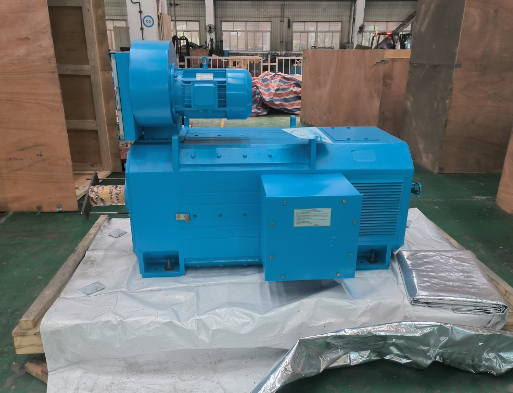


Key Criterion in Heavy-Duty Motor Selection: Engineering Application of Stall Torque in High-Inertia Systems
In industrial drive system design, the performance verification of electric motors during the starting phase has become an increasingly critical aspect of system-level engineering. In particular, for high-inertia applications such as ball mills, crushers, belt conveyors, and industrial compressors, the ability of a motor to deliver sufficient stall torque directly determines the feasibility of successful startup and long-term operational reliability.
In recent engineering practice, a common issue in system integration design is the excessive reliance on rated power as the primary selection criterion, while insufficient attention is given to low-speed torque capability. This can lead to insufficient starting margin, resulting in failed startups, unstable acceleration behavior, or long-term thermal stress accumulation in real operating conditions.
Therefore, establishing a stall torque–based evaluation methodology is essential for improving the accuracy and robustness of motor selection in heavy-duty applications.
1. Engineering Definition and Characteristics of Stall Torque
Stall torque (Locked-Rotor Torque) refers to the electromagnetic torque developed by an electric motor when the rotor is completely stationary under rated voltage and rated frequency conditions.
According to IEC 60034 and related international motor standards, stall torque is defined as a key parameter for describing motor starting performance, representing the capability of the motor to overcome static friction, system inertia, and external resistance at zero speed.
It is important to note that stall torque does not represent continuous operating capability. Instead, it reflects the electromagnetic torque limit under zero-speed transient conditions, governed by the motor’s electromagnetic design constraints.
2. Engineering Criteria for High-Inertia Applications
In high-inertia systems, motor starting behavior is fundamentally a dynamic torque balance process, where successful acceleration depends on the interaction between motor torque output and load resisting torque throughout the speed-up phase.
Based on established engineering practice, a minimum stall torque of 2.0 times rated torque is generally considered necessary to ensure reliable starting under heavy-duty conditions.
For high-inertia or frequent-start applications—such as long-distance conveying systems, large crushers, and high-pressure industrial compressors—a design margin of 2.0 to 2.4 times rated torque is typically recommended to reduce the risk of stalled starts, insufficient acceleration, or excessive thermal loading.
It should be emphasized that this range is an engineering guideline rather than a standardized requirement, and should be evaluated in conjunction with load inertia, required acceleration time, and power supply conditions.
3. Common Engineering Deviations and Selection Risks
A frequent design issue in industrial projects is the overemphasis on rated power as the primary selection parameter, while neglecting low-speed torque characteristics of the motor.
Although this approach may be acceptable for low or medium inertia systems, it can lead to insufficient starting capability in high-inertia applications.
When stall torque is insufficient, even motors with adequate rated power may fail to accelerate the load, resulting in prolonged low-speed operation or complete starting failure.
Therefore, rated power alone is not sufficient to characterize motor starting capability. A more comprehensive evaluation based on the complete torque–speed characteristic is required for accurate system design.
4. System-Level Role of Stall Torque
From a system engineering perspective, stall torque not only determines starting success but also significantly influences current characteristics and mechanical stress distribution during the acceleration phase.
Appropriate torque margin design can improve acceleration stability, reduce inrush current impact, and mitigate torsional vibration in the drivetrain system. This helps reduce fatigue loading on key components such as bearings, shafts, and couplings.
In long-term operation, such optimization contributes to improved system reliability and reduced risk of unplanned downtime.
5. Conclusion
Stall torque is a fundamental parameter in motor starting performance and plays a critical role in heavy-duty and high-inertia industrial applications.
By adopting a standardized evaluation methodology centered on stall torque and integrating load inertia and dynamic system behavior into the design process, engineers can significantly improve selection accuracy, reduce iterative verification efforts, and enhance overall system reliability and operational robustness