




0102030405
IC611 vs. IC616: Is Forced Cooling Necessary for Fixed-Speed Motors?
2026-07-20
IC611 vs. IC616: Is Forced Cooling Necessary for Fixed-Speed Motors?

[Technical Guide]
In high-voltage motor procurement for mining, power generation, building materials and petrochemical sectors, choosing between IC611 and IC616 cooling systems is a frequent dilemma for engineers and purchasers. Many hold a common misunderstanding that IC616 always delivers superior cooling performance and should be prioritized for all projects. As a result, buyers tend to raise budgets for IC616 upgrades, even if their motors will only run at a constant 50Hz without any variable frequency drive (VFD) configuration. Supported by abundant field operation data and IEC international standards, this guide clarifies the applicable limits of the two cooling structures to help enterprises cut unnecessary procurement and maintenance costs.
Structural Comparison: External Secondary Fan Driving Modes
According to IEC 60034-6 cooling standards, both IC611 and IC616 are totally enclosed high-voltage motors equipped with top air-to-air heat exchangers. They adopt identical internal air circulation channels, with built-in impellers fixed to the main shaft and rotating synchronously with the rotor speed.
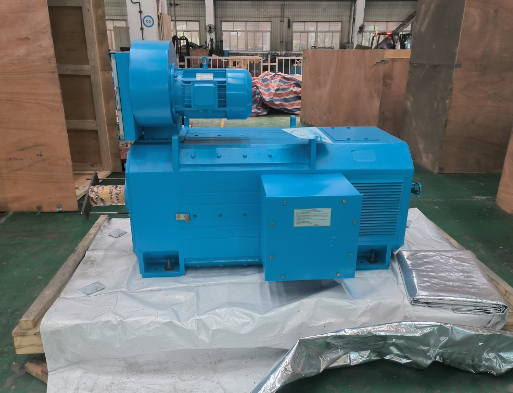
The core technical difference lies in the driving method of the external secondary cooling fan. The IC611 coaxial self-cooling design installs the external fan on the non-drive end of the rotor shaft, rotating synchronously with the main motor. It requires no separate power supply or additional wiring, featuring a compact mechanical layout and fewer moving wearing parts. In contrast, the IC616 forced ventilation system matches the heat exchanger with an independent auxiliary fan motor with dedicated power supply. This auxiliary fan maintains a constant rotating speed regardless of the main motor’s operating frequency, delivering stable cooling airflow to the heat exchanger all year round.
Fixed 50Hz Operation: IC611 Delivers the Best Cost Efficiency
When a motor runs continuously at the rated 50Hz grid frequency, IC611 can fully meet heat dissipation demands under standard industrial environments. At a steady 50Hz rated speed, the coaxial fan operates at full capacity, generating sufficient airflow through the heat exchanger to take away heat produced by winding and core loss, keeping temperature rise within standard safe ranges.
For production lines with normal ambient temperature, stable load and sound natural ventilation, standard IC611 brings prominent economic and operational advantages. It saves extra investment on standalone fans, auxiliary terminal boxes and independent power circuits. Meanwhile, removing one extra rotating component reduces hidden faults such as fan bearing wear and auxiliary coil burnout, as well as extra power consumption from the secondary cooling fan.
Special Operating Conditions: Three Scenarios Where IC616 Is Worth Upgrading for Fixed-Speed Motors
IC616 is originally designed to solve overheating risks during low-speed VFD operation. Even without speed regulation demands, it is still a reasonable upgrade choice for fixed-frequency motors under three harsh working conditions. First, units running 24/7 under full load or slight continuous overload produce massive heat, which requires extra cooling margin to limit temperature rise and slow insulation aging. Second, enclosed, high-temperature and dusty workshops with poor natural ventilation cannot obtain enough thermal redundancy from standard IC611 structures. Third, if the project reserves later VFD renovation plans, pre-equipping IC616 avoids high costs caused by secondary motor replacement and site reconstruction.
Selection Recommendations: A Hierarchical Matching Method
Blindly upgrading fixed-speed motors to IC616 will cause unnecessary capital waste. Under constant-speed operation, the core advantage of constant independent fan airflow cannot be fully utilized, and annual maintenance expenses of the auxiliary fan cannot be offset by limited cooling improvement.
Engineering teams suggest selecting cooling schemes based on actual working conditions. IC611 coaxial self-cooling is the top pick for standard 50Hz fixed-speed equipment with stable load and ordinary workshop environments, featuring low overall cost, simple structure and zero auxiliary fan maintenance. IC616 forced ventilation is suitable for high-temperature, enclosed, dusty or long-term heavy-load production sites, offering sufficient thermal margin to control temperature rise and extend winding service life. For equipment requiring long-term low-frequency variable speed operation, IC666 fully independent forced ventilation is the reliable solution, whose separate internal and external air loops guarantee stable heat dissipation at low rotating speeds.
Reasonable matching of cooling configurations avoids both insufficient heat dissipation risks and excessive over-investment, which is a vital step to lower the full life-cycle operation cost of heavy-industry high-voltage transmission equipment.