


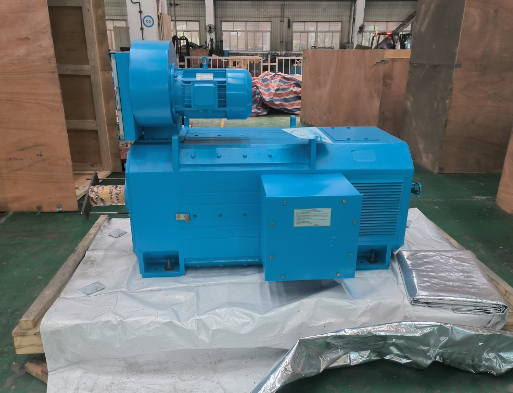


What type of motor is suitable for ball mill equipment?
Generally speaking, different equipments have different motor types and different use environments, so there are many types and speeds of motors. In the production of cement, silicate products, new building materials, refractory materials, fertilizers, black and non-ferrous metal beneficiation, glass and ceramics, ball mills are often used. So what kind of motor should be selected for ball mills? There are mainly the following series.

The first is asynchronous motors. Except for small ball mills that use squirrel cage motors for driving, most small and medium-sized ball mills use three-phase winding Asynchronous Motors for driving. The main disadvantage of asynchronous motors in ball mill driving is that they are simple and cheap, have sufficient starting torque, can directly start the ball mill, and are controlled by connecting the series resistance of the rotor winding. The second is synchronous motors. There are two types of motors for driving ball mills, namely general low starting torque synchronous motors and large low-speed high-torque synchronous motors for ball mills. The last is the induction synchronous motor. It has the following advantages: it has the advantages of large starting torque but small starting current when starting, and has the advantage of advanced power factor than synchronous motor when working, thus solving the problem of inertial compensation of cement plant power grid. The disadvantage is that the manufacturing is complicated and the price is expensive, but the induction synchronous motor has a promising future as the transmission motor of large ball mill motor.
When selecting the ball mill motor, in addition to considering the above-mentioned motor characteristics, the initial investment and operating costs must be taken into account. Consider the motor type of other equipment in the cement plant, that is, the power factor of the power supply network of the whole plant. When determining the rated voltage, the transformer status of the power grid in the area where the cement plant is located and the size of the power grid capacity should be considered. The motor should be identified in accordance with the mechanical transmission plan of the ball mill, and the mechanical manufacturing conditions of the deceleration mechanism should be considered when evaluating.