


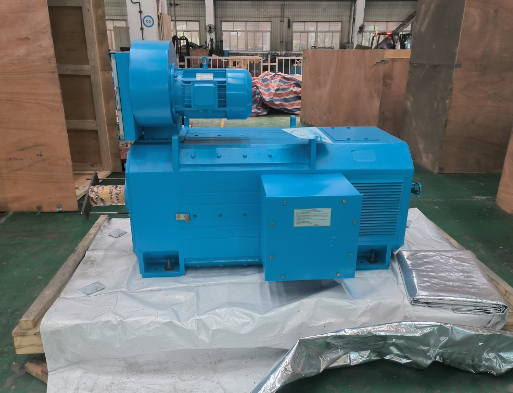


What is the difference between AC motor and DC motor?
AC motors by LT SIMO are designed to run on alternating current, which means that the current changes direction and magnitude in a cyclic pattern. AC motors are often used in applications that require high power output and continuous operation, such as industrial machinery, pumps, compressors, and HVAC systems. There are several types of AC motors, including Induction Motors, synchronous motors, and brushless AC motors.
Induction Motors: Induction motors are the most common type of AC motor and are widely used in industrial applications. Induction motors consist of a stator (stationary part) and a rotor (rotating part) separated by an air gap. When AC current is applied to the stator windings, it creates a magnetic field that induces current in the rotor windings, which in turn creates a magnetic field that interacts with the stator field, causing the rotor to rotate.
Synchronous Motors: Synchronous motors are another type of AC motor that runs at a fixed speed and are often used in applications that require precise timing and control, such as electronic clocks and timers. Synchronous motors consist of a rotor with permanent magnets and a stator with electromagnets. When AC current is applied to the stator windings, it creates a rotating magnetic field that interacts with the rotor's magnetic field, causing the rotor to rotate at a fixed speed.

Brushless AC Motor: A brushless AC motor is an AC motor that uses electronic control to sequentially switch current to the stator windings, creating a rotating magnetic field that drives the rotor. Brushless AC motors are often used in applications that require high efficiency and precise control, such as robotics, automation, and electric vehicles.
Dc Motor: DC motors, on the other hand, require a constant, stable DC current to function properly. DC motors are often used in applications that require precise control and efficiency, such as robotics, electric vehicles, and renewable energy systems. DC motors can be divided into several types, including brushed DC motors and brushless DC motors.
Brushed DC Motor: The simplest and most common type of DC motor, the brushed DC motor consists of a rotor with coils and a stator with permanent magnets. When current is applied to the coils, it creates a magnetic field that interacts with the permanent magnets, causing the rotor to rotate. Brushed DC motors are often used in small electronic devices, such as toys, appliances, and power tools.
Brushless DC Motor: A brushless DC motor is a more complex DC motor that uses electronic control to sequentially switch current to the stator windings, creating a rotating magnetic field that drives the rotor. Brushless DC motors are often used in applications that require high efficiency and precise control, such as robotics, automation, and electric vehicles.
Main Differences: The main differences between AC and DC motors can be summarized as follows:
- Current: AC motors use alternating current, while DC motors require a constant, stable DC current.
- Structure: AC and DC motors have different internal structures, AC motors typically have a stator and rotor, while DC motors have fixed magnets and rotating coils.
- Power Supply: AC motors are typically connected to the grid or AC power supply, while DC motors are typically powered by batteries, rectifiers, or DC power supplies.
- Speed Control: DC motors are easier to control and maintain a constant speed than AC motors, which can be challenging to control and maintain a steady speed.
- Efficiency: DC motors are generally more efficient than AC motors, especially at lower speeds and when used in applications that require precise control.
In general, the choice of LT SIMO Motor's AC and DC motors depends on the specific application and requirements. AC motors are typically used in applications that require high power output and continuous operation, such as industrial machinery and HVAC systems, while DC motors are typically used in applications that require precise control and efficiency, such as robotics, electric vehicles, and renewable energy systems.