


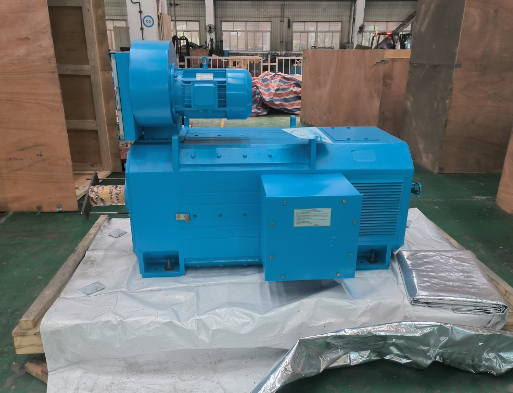


What are the characteristics of variable frequency motors?
The low-voltage variable frequency motors produced by LT SIMO Motor have the following characteristics
- Electromagnetic design: For ordinary Asynchronous Motors, the main performance parameters considered during redesign are overload capacity, starting performance, efficiency and power factor. For variable frequency motors, since the critical slip is inversely proportional to the power frequency, they can be started directly when the critical slip is close to 1. Therefore, overload capacity and starting performance do not need to be considered too much, and the key issue to be solved is how to improve the motor's adaptability to non-sinusoidal power supplies. The methods are generally as follows:
1) Reduce the stator and rotor resistance as much as possible.
Reducing the stator resistance can reduce the fundamental copper loss to compensate for the increase in copper loss caused by high-order harmonics
2) In order to suppress high-order harmonics in the current, the inductance of the motor needs to be appropriately increased. However, the larger the rotor slot leakage reactance, the larger the skin effect, and the higher harmonic copper loss. Therefore, the size of the motor leakage reactance must take into account the rationality of impedance matching within the entire speed regulation range.
3) The main magnetic circuit of the variable frequency motor is generally designed to be unsaturated. First, it is considered that high-order harmonics will deepen the saturation of the magnetic circuit. Second, it is considered that at low frequency, the output voltage of the inverter should be appropriately increased in order to increase the output torque.

- Structural design
When designing the structure, the main consideration is the impact of non-sinusoidal power supply characteristics on the insulation structure, vibration, noise cooling method and other aspects of the variable frequency motor. Generally, the following issues should be paid attention to:
1) Insulation level, generally F level or higher, strengthen the insulation to the ground and the insulation strength of the wire turns, and especially consider the ability of the insulation to withstand impulse voltage.
2) For the vibration and noise problems of the motor, the rigidity of the motor components and the whole should be fully considered, and its natural frequency should be increased as much as possible to avoid resonance with each force wave.
3) Cooling method: Generally, forced ventilation cooling is adopted, that is, the main motor cooling fan is driven by an independent motor.
4) Measures to prevent shaft current, bearing insulation measures should be adopted for motors with a capacity of more than 160KW. Mainly, it is easy to produce magnetic circuit asymmetry and shaft current. When the current generated by other high-frequency components is combined, the shaft current will increase greatly, resulting in bearing damage, so insulation measures are generally taken.
5) For constant power variable frequency motors, when the speed exceeds 3000/min, high-temperature resistant special grease should be used to compensate for the temperature increase of the bearing.
Variable frequency motors can operate for a long time in the variable frequency range of 0.1HZ--130HZ.
Ordinary motors can run for a long time in the range of: 20--65hz for 2 poles.
25--75hz for 4 poles.
30--85hz for 6 poles.
35--100hz for 8 poles.